
Discovery
Clarify product, site, capacity and the decision required. Agree the assignment, inputs and commercial terms.
Engineering / GiNOVA
Connect product requirements, process design, equipment selection and supply coordination in one engineering brief. We structure the technical work, producer enquiries and implementation decisions around the product you need to make.
Discuss your processProtect product integrity. Define water management, cold-chain and packaging interfaces together.
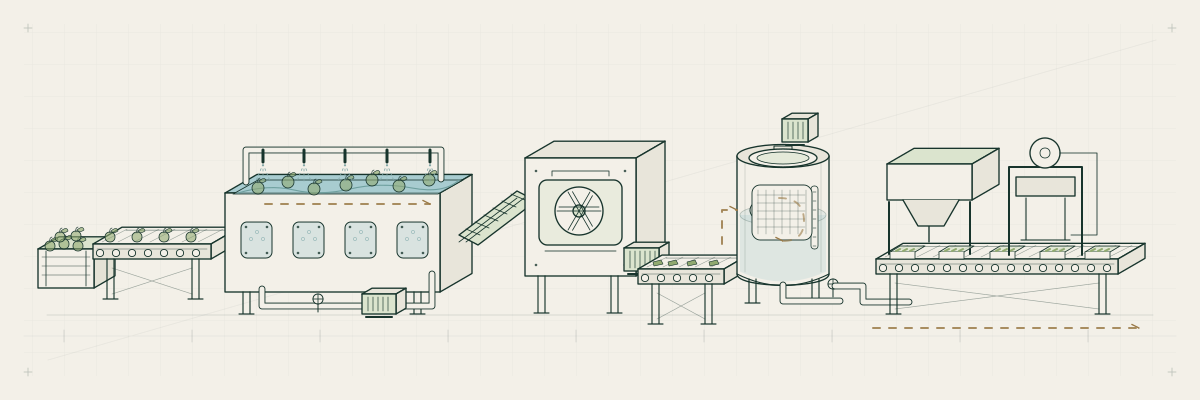
Product & supply: specification, quality, seasonality and producer coordination.
Process & equipment: product behaviour, capacity and hygienic interfaces.
Development: formulation, process window, stability and unit-cost assumptions.
Investment: utilities, labour, integration and acceptance criteria.
Service scope · outputs agreed per project
Select a process or project need. See the variables that matter, the work to resolve them and the decision material you receive.
Best suited forAn international ingredient or intermediate-product requirement with several producer or processing options.
Grade, composition, quality tolerances and processing behaviour must fit the receiving operation. Seasonality, batch traceability, intermediate processing and logistics can change the supply decision.
Translate the purchasing need into a technical enquiry; compare producer responses against shared criteria; coordinate samples and record responsibilities at each handover.
A specification and producer comparison, sample-approval record and supply responsibility map.
Best suited forA new or upgraded salad and fresh-cut line where quality and handling constraints must guide equipment selection.
Cut geometry and tissue damage affect oxidation and product quality. Wash-water management, dewatering, cold-chain continuity and modified-atmosphere packaging must be considered together.
Map preparation, washing, cutting, dewatering and packing. Translate capacity and product requirements into supplier questions and a trial plan, with food-safety validation assigned to the responsible specialists.
A process-flow concept, equipment requirement brief and register of trial and validation questions.
Best suited forA drying investment or product change that needs a product-specific route and trial plan.
Feed size, loading, temperature–time history and air conditions shape drying behaviour. Water activity, moisture, texture, colour and energy demand belong in the same product brief.
Compare applicable drying routes; define product-specific trials; record yield, energy and quality assumptions before equipment commitments.
A drying-route comparison, trial matrix and supplier enquiry with acceptance targets to be verified.
Best suited forA juice line or product brief where yield, pulp, preservation and filling choices must be aligned.
Fruit condition, extraction yield, pulp specification and enzyme activity influence the process. Oxygen pickup, concentration, preservation and filling route change product-quality and equipment decisions.
Connect preparation, extraction, separation, treatment and filling. Define interfaces and identify the product trials and supplier evidence required for the intended distribution conditions.
A process outline, equipment enquiry and register of quality, utility and validation decisions.
Best suited forA new formulation or process change moving from a concept into structured trials.
Formulation, ingredient variability, process window, stability and target unit cost must be defined together. Scale-up changes mixing, heat transfer, residence time and handling.
Set target attributes and a baseline; structure staged trials; separate measured findings from hypotheses and identify what must be checked again before scale-up.
A development brief, trial matrix, findings record and next-stage decision brief.
Best suited forAn investment or implementation decision with competing supplier scopes and unresolved site interfaces.
Capacity balance, utility demand, labour assumptions, layout and hygienic interfaces must agree with the investment model. Automation boundaries and commissioning acceptance cannot remain implicit.
Compare technical scenarios and supplier scopes; identify missing site data, interfaces and acceptance questions; coordinate agreed project or on-site activities within a written mandate.
A technical feasibility note, interface and responsibility register, and staged implementation action list.
Food-engineering knowledge connects product behaviour to process choices. International producer sourcing and supply-flow coordination connect those choices to technical enquiries, samples and agreed responsibilities.
The proposal identifies who will do the work, which specialist input is needed and what evidence supports the recommendation.
Clarify product, site, capacity and the decision required. Agree the assignment, inputs and commercial terms.
Examine process options, supplier information and missing evidence. Identify trials and specialist responsibilities.
Receive the agreed comparison, technical brief and open-issue register, with assumptions and acceptance points visible.
Where separately included in scope, coordinate supplier interfaces, site questions and progress against agreed milestones.
Assignments are accepted against a defined scope, available information, agreed outputs and clear decision responsibilities. Performance, investment return and regulatory outcomes require their own supporting evidence.
Required expertise, authority and acceptance criteria are agreed upfront. Specialist design, food-safety validation and statutory approvals require identified responsible parties.
Any representation, brokerage or commercial role is agreed before work starts, including purchasing authority, logistics responsibilities and the limits of on-site representation.
Engineering & Consultancy, Decision Systems and SoundLab are three parallel areas within GiNOVA, connected by a shared engineering perspective.
COMMISSION A DEFINED SCOPE
Describe the decision, engineering challenge or creative production you have in mind. The next step is a written scope covering deliverables, inputs, responsibilities, timing and price.